



By Liman Ahore Solomon.
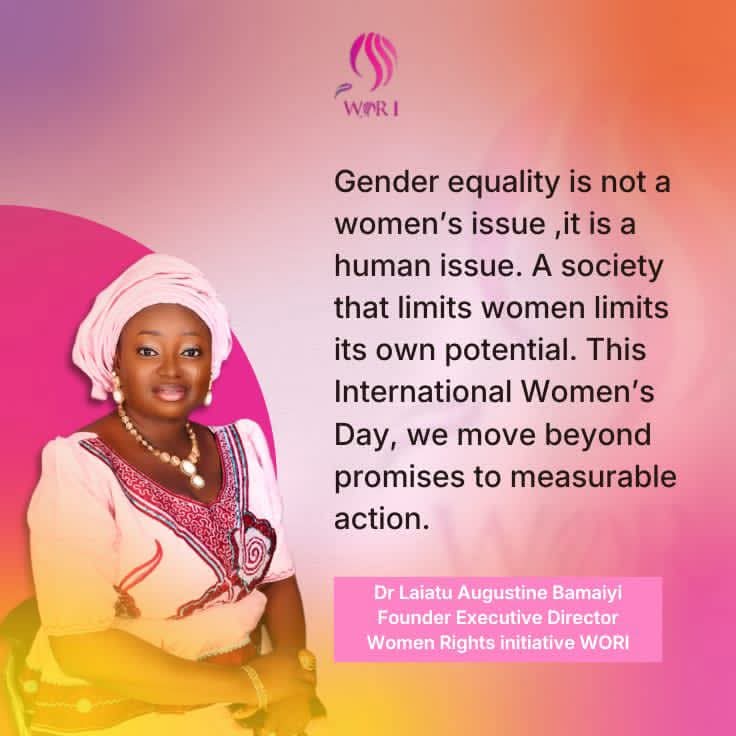
As the world marks International Women’s Day 2026, the Women Right Initiative (WORI) has called for renewed commitment from governments, institutions and civil society groups to advance the rights, equality and empowerment of women and girls.
In a statement issued on Sunday to commemorate the global event, the Founder of the organisation, Dr Laiatu Augustine Bamaiyi, said this year’s theme, “For ALL Women and Girls: Rights. Equality. Empowerment.” serves as a reminder that symbolic gestures are no longer sufficient in addressing the persistent inequalities facing women across the world.
According to her, while the international community has made measurable progress in promoting gender equality over the years, many women and girl particularly those in rural and vulnerable communitie continue to experience systemic barriers that limit their full participation in social, political and economic life.
She noted that challenges such as limited access to quality education, economic inequality, underrepresentation in leadership positions and exposure to gender-based violence remain widespread in many societies.
“International Women’s Day is not only a moment of celebration but also a global accountability point,” Bamaiyi said. “It reminds us that empowering women is fundamental to achieving sustainable development, peace and economic growth.”
She stressed that global evidence consistently shows that when women are educated, economically empowered and actively involved in decision-making processes, families, communities and nations experience greater prosperity and stability.
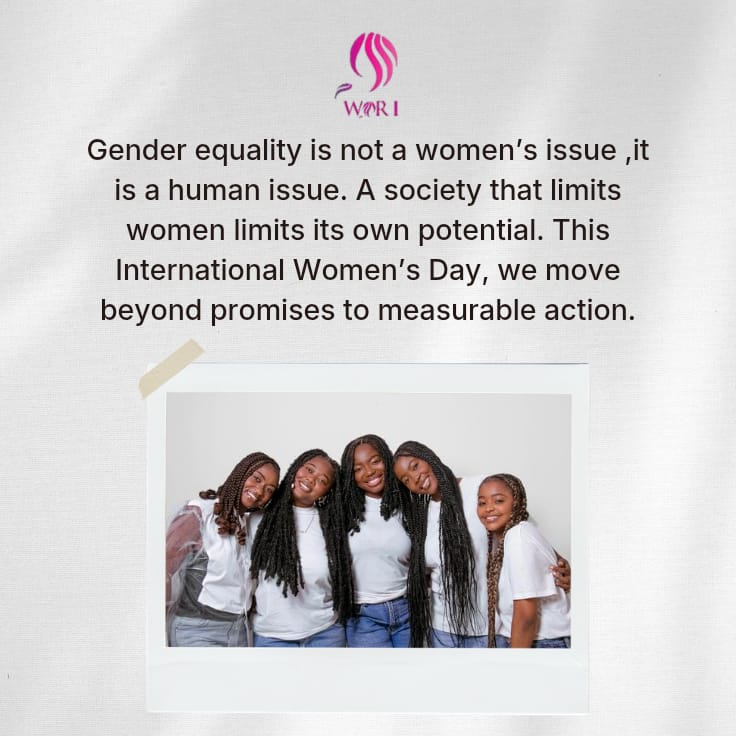
The WORI founder therefore urged governments and stakeholders to adopt stronger policies that protect women’s rights and eliminate all forms of discrimination.
She also called for increased investment in girls’ education, digital inclusion and leadership development programmes aimed at preparing women and girls for greater participation in the modern economy.
Bamaiyi further emphasised the need to expand equal economic opportunities for women through improved access to finance, land ownership and entrepreneurship support, while advocating greater representation of women in political and decision-making spaces.
She also called for intensified collective action to prevent and respond effectively to gender-based violence.
According to her, meaningful progress towards equality will remain elusive if women and girls in marginalised, rural and conflict-affected communities are left behind.
“True equality cannot be achieved if any woman or girl is excluded,” she said. “Inclusive empowerment must remain at the centre of national and global development agendas.”
As the world commemorates International Women’s Day 2026, Dr Bamaiyi urged stakeholders at all levels to move beyond declarations and ensure that commitments translate into measurable outcomes that improve the lives of women and girls.
“The time for incremental change has passed,” she added. “This moment calls for bold leadership, accountability and sustained investment in women and girls so that equality becomes institutionalised rather than aspirational.”
She concluded by stressing that the message of this year’s commemoration remains clear: the pursuit of rights, equality and empowerment for all women and girls must remain a shared global responsibility
